
Description
Problem
Water hardness.
Unit description
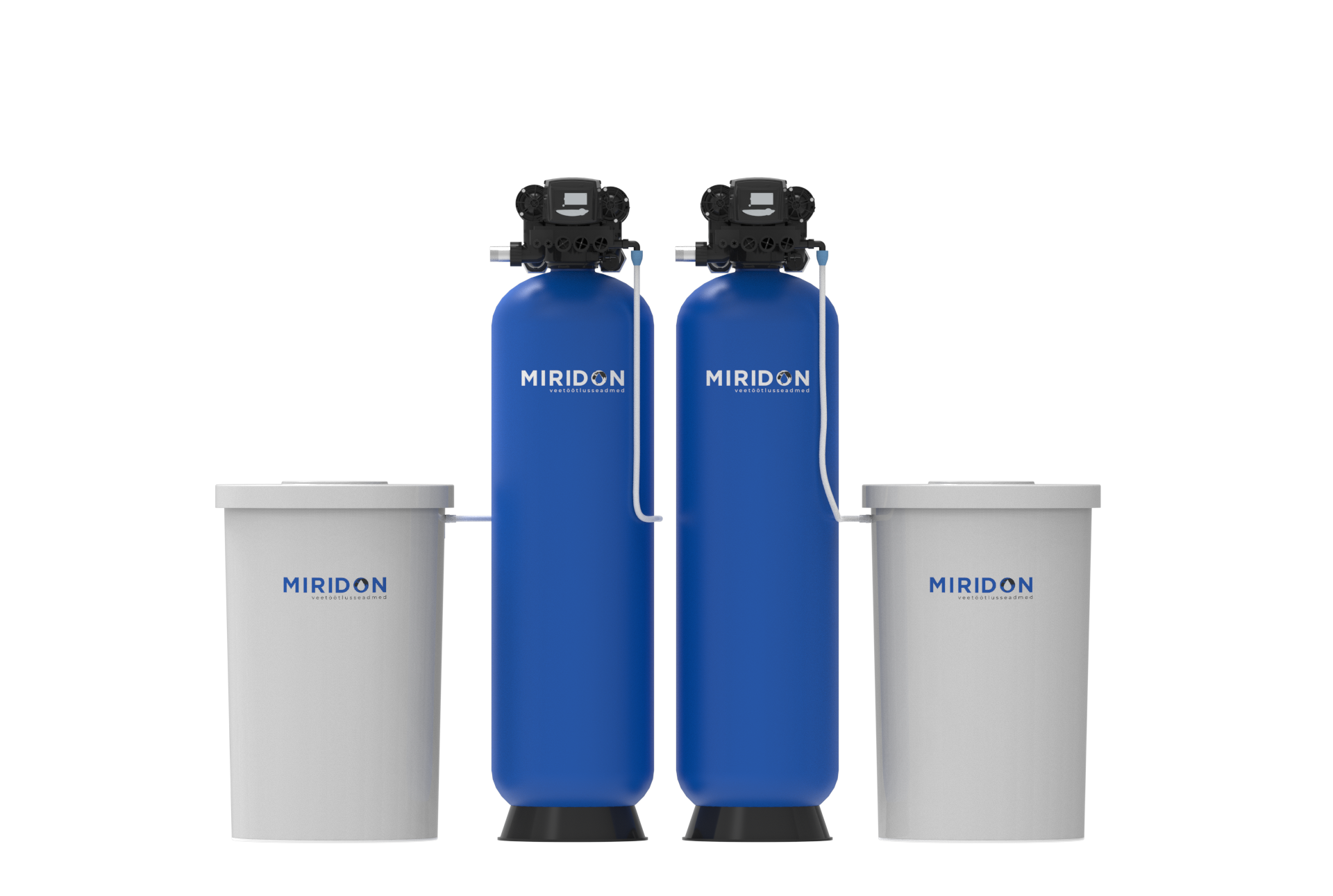
The water softener is designed to remove hardness (i.e. the calcium and magnesium ions contained in the water). The water treatment unit consists of a vessel filled with filter media, a fully automatic controller that manages the filter’s operation and a brine tank. The filter medium is an ion exchange resin made specifically for water treatment.
Intended use
The unit is used when treated water must be available at all times (including during backwashing).
The unit can be started in two ways.
1. Duplex unit – the filter vessels work alternately, i.e. one vessel is in service while the other is on standby. When the capacity of the first vessel is exhausted, the second vessel goes into service and the first vessel goes into backwashing. When backwashing finishes, the washed vessel remains on standby until the capacity of the other vessel is exhausted. The duplex unit is the most efficient, because the capacity can always be used up completely without the risk of hard water leaking through.
2. Parallel unit – the filter vessels work at the same time but go into backwashing at different times. Each filter vessel has its own water meter, which the unit uses to decide when backwashing is needed. When one unit is backwashing, the other unit does not go into backwashing at the same time but waits until the first unit has finished. For this reason, the backwash start of a parallel unit is programmed with a small margin. A parallel unit is used when continuous soft water is important, but the capacity of a single filter vessel is occasionally insufficient and, for technical reasons, larger filter vessels cannot be used.
Operating principle
In the unit, the calcium and magnesium ions dissolved in the water are replaced with sodium ions. The unit works fully automatically, performing backwashing, i.e. regeneration, according to consumption. The user’s task is to make sure there is always enough of a supply of salt tablets in the brine tank. The installation site needs an electrical outlet and a drain connection.
Technical data
| Flow rate, maximum | 12 m³/h** |
| Operating pressure | 2–8 bar |
| Operating temperature | +5 to +30 °C |
| Electrical connections | 230 VAC / 50 Hz |
| Backwash water volume* | 2037 l** |
| Capacity at total hardness of 1 meq/l | 288 m³** |
| Filter media | cation resin, support gravel |
| Unit dimensions (L x W x H) | 2870 x 720 x 2570 mm |
| Connections (inlet, outlet, drain, pilot valve drain) | 2″ male thread, 2″ male thread, 1 1/2″ male thread, 1/4″ hose |
* Water consumption is calculated per backwash at an inlet pressure of 3.4 bar (under the standard program).
** Data given for one filter vessel.
Unit components
- Controller
- Timer
- Filter vessel
- Upper screen
- Filter media
- Center tube
- Support gravel
- Lower screen
- Brine hose
- Brine tank
- Brine tank overflow
- Brine well
- Salt tablets
- Brine solution
Unit connections
- Outlet – 2″ male thread
- Drain – 1 1/2″ male thread
- Inlet – 2″ male thread
- Pilot valve drain – 1/4″ hose
