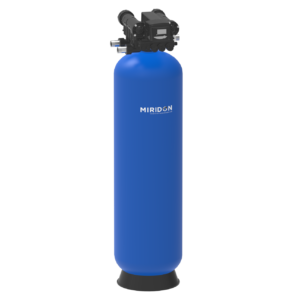

Excess iron content directly affects the reliability of equipment, the quality of production processes and a company’s day-to-day costs. A properly selected iron removal system removes both dissolved and precipitated iron from the water, preventing blockages, rust stains and costly maintenance.
Industrial systems work automatically and ensure stable water quality that meets the standards, which is critical for both production and infrastructure.
Miridon offers a complete solution from design through installation to maintenance, ensuring maximum reliability.
Excess iron in water is a common problem that affects both production processes and the reliability of the water supply. Because of iron content above the norm, the water becomes cloudy, rust stains appear on pipes and equipment, and the risk of blockages increases. This in turn increases maintenance and energy costs.
A reliable iron removal system is essential for ensuring quality drinking water, protecting infrastructure and preventing production downtime.
When choosing iron removal equipment, the most important thing is to select the right filtration rate – it shows how quickly the water being treated passes through the filter media bed. When the filter unit is selected correctly, it works efficiently and removes excess iron from the water. Enriching the water with oxygen beforehand helps speed up iron separation – this can be done by aeration or by adding a suitable chemical. Iron dissolved in the water oxidizes into an iron precipitate, which is filtered out by the filter media. It is also important to choose a suitable backwash flow rate so that the filter stays clean and reliable.
How does an iron removal system work?
The operation of an iron removal system is based on three successive processes that ensure the removal of excess iron from the water. First comes oxidation, in which the iron dissolved in the water is converted into a precipitated form. This can be done either by enriching the water with oxygen, i.e. aeration, or by dosing special chemicals.
Next comes filtration – the oxidized iron precipitate is separated as the water is passed through the filter media bed. To ensure reliability and an efficient result, the filtration rate must be chosen correctly.
In the final stage, the system takes care of maintaining its own working capacity. For this purpose, the units have automatic backwash cycles that flush the accumulated iron sediment and mechanical particles into the drain. The backwash frequency depends on both the iron content of the water and the amount of water consumed.
Choice of filter media
The filter media is selected according to the water analysis, the desired end result and water consumption. The most commonly used filter media are quartz sand and filter media containing manganese dioxide.
Backwashing the filter media
Iron and mechanical sediment are removed from the filter media in the backwash cycle. Backwashing takes place automatically; for this purpose the filter unit is equipped with either an autonomous controller or automatic valves controlled from the electrical control panel that monitors the operation of the station. Backwashing takes place at a preset frequency, depending on the iron content of the water and the amount of water consumed.
Dosing and aeration
For oxidation, dosing or aeration with air is used before filtration. The principle of dosing is to add a chemical to the water being treated that speeds up the precipitation of the iron dissolved in the water. Aeration consists of enriching the water being treated with oxygen – the iron dissolved in the water reacts with atmospheric oxygen, resulting in trivalent iron precipitating out of the water.
For small and medium-sized consumers (4-20 m³/h), both MGS and MGSP series units are suitable.
Note: to ensure efficient operation of water treatment equipment and optimal water quality, we recommend following the manufacturer’s instructions for installation, use and maintenance.