
Quality water is also part of a modern dairy farm’s success formula
Modern milk production no longer resembles the farm barn of the past in any way, where cows were milked by hand and milk was cooled in the well; it is a high-tech enterprise whose successful management depends on very many different components, including quality water.
The Männiku Piim dairy farm in Roiu, Tartumaa, is one of those modern dairy farms, where milking robots run the show, the farm is heated with the residual heat from the milk cooler, part of the electricity is produced with solar panels, and an automatic analysis system monitors the animals’ health. Only 7 people look after the farm’s 360 dairy cows and 300 young animals.
The average milk yield of Männiku Piim’s cows is 12,850 liters per cow per year, which puts it in Estonia’s top ten. Considering that Estonia is at the very top of the world in milk production per cow, it can safely be said that this is a world-class dairy farm.
Behind the success of Männiku Piim is the company’s manager Avo Samarüütel, who, together with his partners, began developing a modern dairy farm from the large farm of the Kuuste state farm nearly thirty years ago. He has succeeded, and Avo Samarüütel himself can show off the titles of the best dairy cattle breeder of 2010, the best farmer of 2011 and the best agricultural manager of 2018.
But Männiku Piim is not only a dairy farm; the company also manages 1,300 hectares of farmland, growing grain, rapeseed and fodder crops, and in winter, when there is a pause in field work, it does road maintenance under procurements. The efficiency of the agricultural company is shown by the fact that, together with the people working in the barn, the company employs 14 people.
The first DeLaval milking robot in Estonia
Männiku Piim is also the first farm in Estonia to adopt DeLaval’s robotic milking system VMS, in 2007. According to Avo Samarüütel’s recollection, the farm had a project to build a new milking parlor, but after visiting a robotic barn in Denmark there was a radical change of mind, and a robotic barn was built instead.
But the farm’s success is not only down to smart milking robots; the success formula of profitable milk production has many other components, such as breeding, timely pregnancy of the animals, welfare and proper feed. Avo Samarüütel drew a parallel with a barrel – it is enough for one of the staves of the barrel to be shorter than the others for the whole barrel to run empty and for all the work and effort to go to waste.
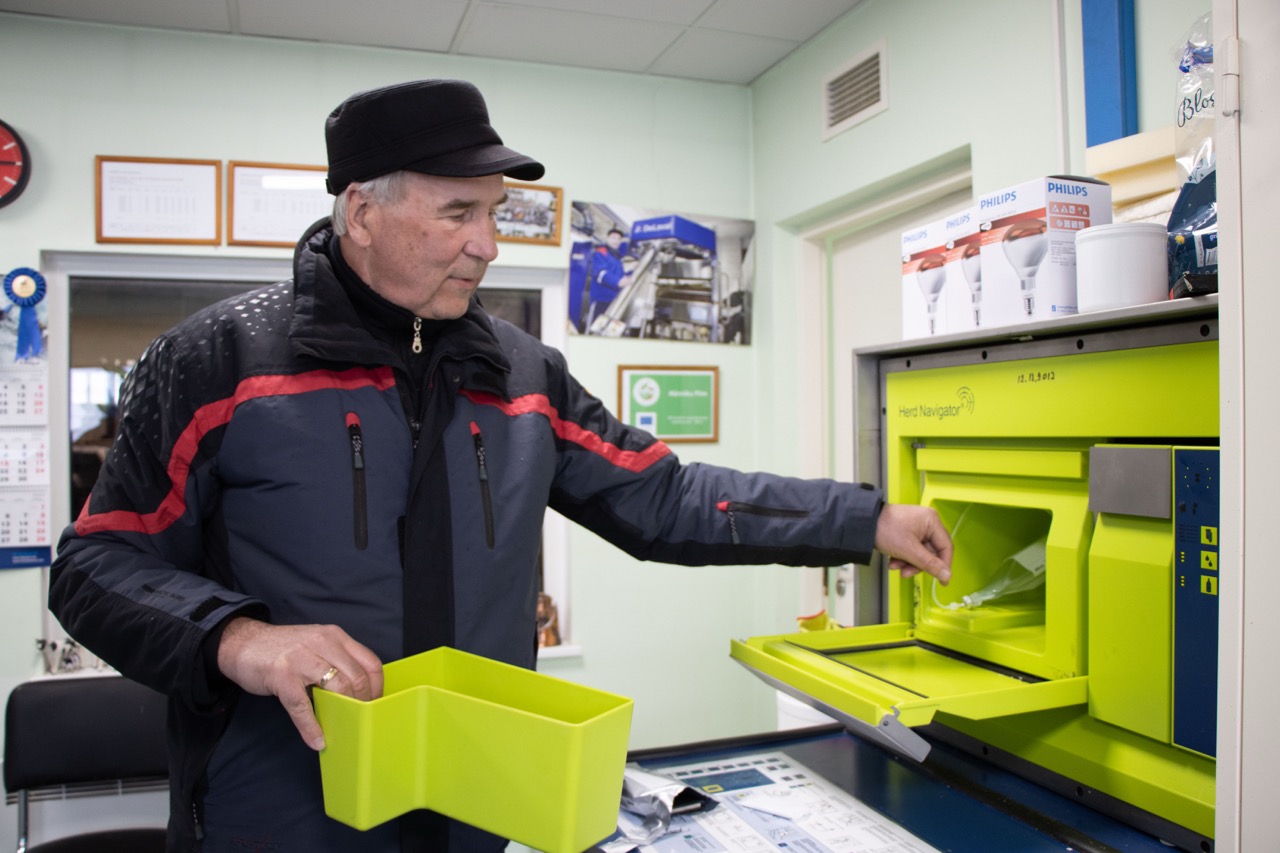
For example, at Männiku Piim the analysis system Herd Navigator helps detect timely heat, which considerably eases the work of the company’s livestock manager, and pregnancy no longer has to be checked by hand; thanks to it the farm’s calving interval is 385 days. In addition, the system helps find animals ill with ketosis or mastitis. “The Herd Navigator did cost 80,000 euros, and that was a lot of money, but now we can say confidently that the system has fully paid for itself,” he said.
One more component of the success formula – quality water
This is where one more component of the success formula comes into play – quality water. The farm is supplied by its own drilled well, and the amount of water consumed daily on the farm is impressive: just one cow at a daily milk yield of 50-60 liters drinks 200 liters of water a day, and in total the farm uses 60 cubic meters of water a day.
The water from the farm’s drilled well is of good quality and controlled, but, as is typical for Tartumaa, it is rich in lime, and this is where Miridon’s water treatment equipment helps. Not all of the farm’s water passes through water treatment equipment, but the water used for cleaning the milk tanks, the milking robots and the Herd Navigator analysis system passes through Miridon’s water treatment equipment.
“We cannot use untreated water in the Herd Navigator at all, because some of the hoses in the system are only as thick as a hair, and calcium-rich water would ruin the expensive equipment,” said Samarüütel.
But that is not all. Männiku Piim also has DeLaval’s new-generation milking robots V300 and V310, which use 3D cameras instead of laser beams, and calcium-rich water makes the camera glass streaky. “The camera is the robot’s eyes, and figuratively speaking, those eyes got a cataract because of the limey water,” he smiled.
That is why Männiku Piim has been using Miridon’s services for many years, because the company knows that even if one small component of the success formula does not work, the expected end result will not be achieved either.
In the photo: Avo Samarüütel. Analysis system Herd Navigator.

