

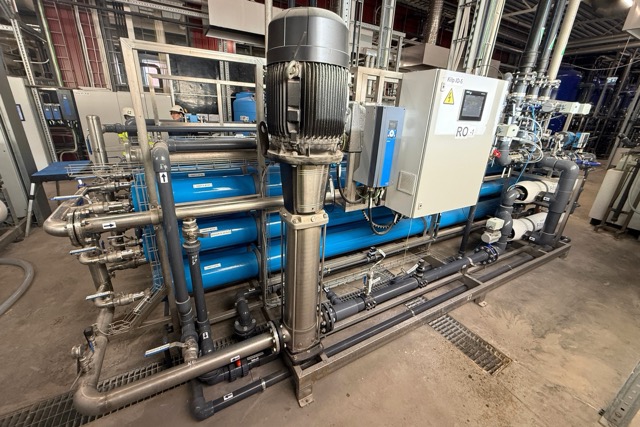
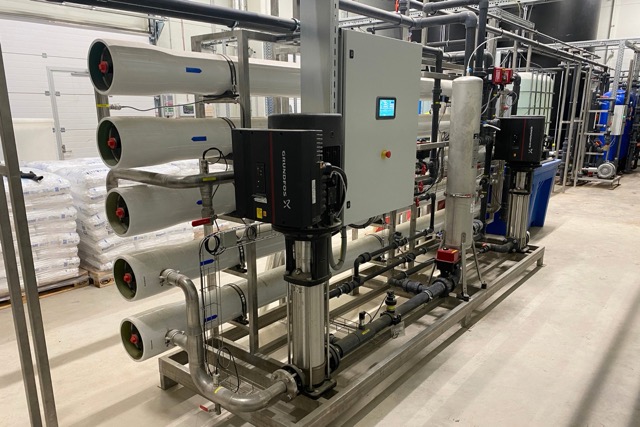
Reverse osmosis is one of the most effective membrane-based water treatment methods, providing businesses with water of the highest purity. It is based on membrane technology, in which a pump forces water through a very fine membrane. The membrane lets only water molecules through, while removing most of the dissolved substances – salts, heavy metals, organic compounds, bacteria and viruses.
Thanks to their excellent filtration capability, RO solutions are used in industries where water purity directly affects the reliability of production processes and the quality of the final product. Thanks to their excellent purification capability, reverse osmosis systems are widely used in water utilities, the food industry, the energy sector, boiler houses, hotels and spas, and other industries where it is important to ensure consistent water quality and high productivity.
Miridon always configures reverse osmosis systems based on the water analysis and the company’s consumption needs, ensuring maximum efficiency and reliability.
For comparison:
- Viruses: 0.02-0.4 microns
- Bacteria: 0.2-10 microns
- RO membrane pore: 0.001 microns
For fresh water, the unit operates at a pressure of 2–17 bar, and for seawater at over 40 bar. The exact operating pressure depends on the type of membrane used.
RO membranes can remove, for example, fluoride, boron, chloride, nitrates, radium and other unwanted substances from the water. For customers with higher consumption, the reverse osmosis unit is selected according to the water analysis and the nature and volume of consumption.
Equipment features
Miridon’s reverse osmosis units are intended for large consumers and are configured according to the customer’s water analysis and consumption needs.
Salt rejection of 95-99% depends on the feed water quality. The units are designed to operate at a maximum feed water TDS value of 1000 mg/l and a water temperature of 5-25 °C.
Standard equipment:
- Low-energy membranes
- Stainless steel frame (AISI304)
- RO PLC controller with conductivity measurement
- Booster pump
- Pre-filter, 5 microns
- Fiberglass membrane housings
- PVC-U piping
- Rotameters for flow measurement
- Glycerin-filled pressure gauges for pressure measurement
Optional equipment:
- Scale inhibitor dosing system
- Permeate flush (diverting the initial permeate to drain)
- Blending unit for dilution
- Stainless steel membrane housings
- Stainless steel piping
- Additional measuring instruments (pressure, flow, pH, conductivity)
- Various customer-specific solutions are possible if needed
Reverse osmosis units are designed to operate under the following conditions:
- Free chlorine – <0.1 mg/l
- Dissolved iron and manganese – ≤ 0.1 mg/l
- Total hardness – <0.1 meq/l (does not apply when dosing a scale inhibitor)
- Total dissolved solids (TDS) – < 1000 mg/l
- Suspended solids – < 0.1 mg/l
- Silt density index (SDI) – < 3
- pH – 2…11
- Oil and grease – 0 mg/l
- Feed water temperature – 5°C – 25°C
- Feed water pressure – 2–4 bar
